
After this blog post goes live, my husband will take me for my knee replacement surgery. I’m unafraid, prepared, and ready because I had the other knee replaced last fall, and I know the drill.
But also because I am a Nurturer/Examplar, that is, a firstborn girl.
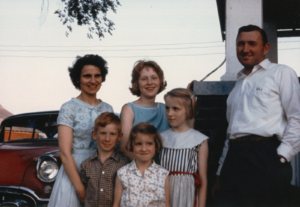
There’s a paucity of research on the family dynamic to which I was consigned. There should be no blame, shame, or regret involved. It’s what happened to the girl in the middle of the photo, and I know that, despite all the blame/shame/regrets, I thrived! I became a woman of strength.
Being an eldest daughter means frequently feeling like you’re not doing enough, like you’re struggling to maintain a veneer of control, as the entire household relies on your diligence. Implicitly, I felt this, especially because two of my siblings had disabilities. My independent dependability was required. My stay-at-home mom was busy.
An online search revealed that most of the oldest sisters report the same. Across social-media platforms, they’ve described the stress of feeling accountable for their family’s happiness, coupled with pressure to excel. All had the impression that they weren’t being cared for in parity with their care for others. My mother told me I was independent – and so, I was.
A term has been coined for this set of feelings and behaviors: “eldest-daughter syndrome.”
That “syndrome” does reflect a real social phenomenon. In many cultures, oldest siblings as well as daughters of all ages tend to face high expectations from family members, so people playing both parts are especially likely to take on a large share of household responsibilities, and might deal with more stress as a result. But that caregiving tendency isn’t inevitable; it tends to be imposed by family members who are part of a society that presumes eldest daughters should conform to a set of standards.

Birth order can also create a hierarchy: Older siblings are often the babysitters, role models, and advice-givers for their younger siblings, though in my experience, they seldom heeded. – ha!
To be clear, birth order doesn’t create one’s personality, but it can influence how your family sees you and, for better or worse, how you understand yourself. Parents frequently compare their children—“‘This is my athlete’; ‘this is my bookworm’; … ‘so-and-so is going to take care of me when I’m old’”—and kids internalize those statements. But your assigned part might not align with your disposition, creating a kind of childhood prison cell.
As soon as I learned to read, I escaped into the other worlds of books. Further, when I started my post-career hobby of creative writing, I created a cast of three characters who lived in small-town settings like those in which I grew up. One was bossy, as the preacher’s wife; another was a spunky, yet traditional housewife; and the final of the gal pals was a secretary, one of the few professions offered to women in the 50s.

All might have been aspects of me, as perceived by my siblings. Which role do you think I made the main protagonist?
A first-born!
I was second. Or last. Either way, I watched my brother screw up sometimes and tried not to emulate him.
And hope all went well with your surgery.
Thanks for your constant caring. Alex