

Writing is an esteemed yet difficult endeavor, a craft to be admired when well done. Via pen or pencil, people bled onto the page, pounded typewriter keys or computer keyboards, stared at walls for inspiration, and chewed nails in deadline desperation. Some took a walk to be re-inspired if blocked. The best authors scribbled words into a cohesive story to emotionally impact readers. (And, I’ve aspired with a little help from my friends, this group)
But along came ChatGPT.
Bada-Bing! AI has officially become the world’s most prolific author. More over Nora Roberts, James Patterson, and Stephen King.
Its fingerprints are ubiquitous, even in students’ assigned papers, to their English professors’ dismay. Worse, in inspirational coffee shop notes insisting that your latte is “woven into your life’s rhythm.” One used to visit coffee shops to commune with friends or dose caffeine while you stared at your laptop hoping to be inspired. Not to receive unbidden psychological boosts along with the physical.
What’s most unsettling isn’t that machines learned to write, It’s that they learned to write in the same voice. Despite being fed famous authors’ work to learn the task, perhaps emulate their deathless prose, for which said authors sued. a distinctive author voice is prized among us human types.
Machines, in an obsessive desire to write right, now overwrite everything they’ve ever been fed and ended up homogeneous rather than distint. Ha!
According to my English professor friend, AI text is easy to spot once you know the signs:
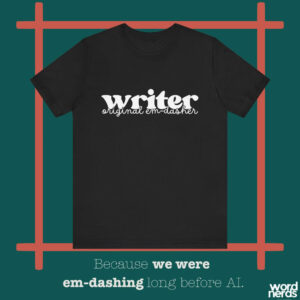
- Em dashes — yes everywhere.
- The “It’s not X, it’s Y” formula — constantly.
- Softly humming metaphors — unsettlingly blindly frequent.
- The word “delve” — enough to bury us all.
- Meticulous attention, meitculously described
My friend related that she asked ChatGPT to sound casual and it replied: “Here’s a meticulously crafted casual remark—woven with quiet intricacy.” Apparently, if you ask it to be funny and it gives you “tickling.”
Thank goodness, resonant, effective comedy, distinctive voice, and soulful writing remain human turf –

While AI can be used to write stories quickly, it doesn’t mean they’re good. And we all have a writer’s voice that can’t be replicated, as you say. You’ve nailed some telltale signs that the writing as been written by Al.
thanks for your read and acknowledgement – may real writers never be swamped by the ever-present pressure of AI advances.
Yeah, AIs are frighteningly efficient – in English. I wonder: are they the same in every language?
Ah, Olga, as we all know from our school years, when one wonders, the teacher assigns one the research and then write the paper…
You are so right. It is quite easy to see when readers get their comments from AI. Yuck and yikes.
Double yuck and yikes!!
And that AI writing is creeping into everything…
I applaud AI’s assistance with medical diagnosis and treatment, but let us pray that AI isn’t employed to write sermons or songs.
Ugh AI. I am not AI, and I use em dashes all the time! Leave creative things to humans and let AI focus on the rest so we have more time to do what we enjoy.
I, too, rely on em dashes to punctuate… (as well as ellipses) It reflects how I think and speak, I suspect. I don’t like AI’s co-opting and downgrading my creative proclivity –